

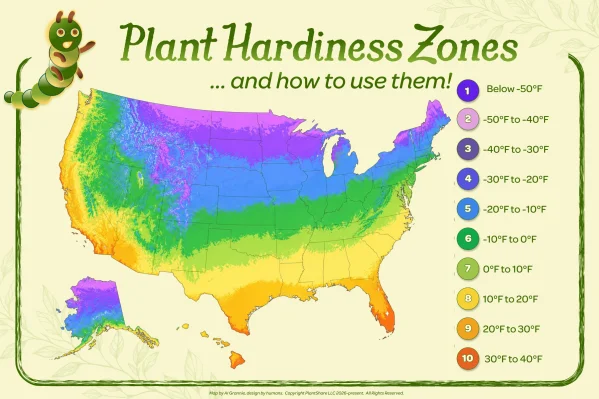
Plant Hardiness Zones and How to Use Them
PlantShare LLC, copyright 2026-present. All Rights Reserved.
Understanding the outdoor environment where you live is essential for all gardeners. The climate zone where you live restricts the plant species that can live and thrive in your outdoor garden. Plants that do not grow in your climate zone simply cannot grow throughout the year where you live unless you grow them indoors or in a greenhouse.
Growers often sell plants to local nurseries that are ‘hardy’ (i.e. will live through the winter) outside your climate zone as ‘annuals’ and online vendors sometimes ship plants to consumers who live in climate zones where the plants cannot live. You can spend a lot of money on these plants and be very disappointed that they do not return next year. You might even think that the label was wrong or you have failed in some way!
However, you can set better expectations, save money, and enjoy more success with both gardening and seasonal planting in just 3 simple steps:
- Find your plant hardiness zone;
- Learn how to read the labels on the plants, so you know what to expect;
- Find the right location in your garden where each plant will thrive.
While this guide explains the basics in a simple and practical way, only the first of these 3 steps is easy and straightforward. You can learn to read labels and ask questions of the nursery where you buy plants to deal with step 2, but step 3 - finding the right location in your garden, the ‘micro-climate’ can require decades of experience.
How Are Climate Zones Determined?
A climate zone is a number that summarizes the weather in a particular place on Earth. Many factors, such as rainfall, wind, soil and air temperature, are used to assess climate conditions, but the primary one is air temperature during the hottest and coldest times of the year: summer and winter. As weather is crucial to food production, cultures around the world have independently developed their own scales based on factors of their choosing; not all the scales use the same factors and some are more detailed than others. This causes confusion for home gardeners and commercial growers alike! There are now efforts to create a universal scale for the entire globe to use on a common set of factors. This blog focuses on just one widely used scale that was developed and is maintained by the USDA.
What Are Plant Hardiness Zones?
Plant hardiness zones are geographic areas defined by average minimum winter temperatures. Plants assigned to that zone can ‘harden’ or are ‘hardy’ outdoors in that climate zone. In other words, this one number tells you exactly which plants can ‘overwinter’ in your region.
The United States Department of Agriculture, USDA, created this particular numerical system. It divides the country into zones based on how cold it gets in winter. Each zone represents a specific plant hardiness zone range.
For example, Zone 3 is much colder than Zone 9. Plants that survive in Zone 9 will NOT survive outdoors in Zone 3.
The system also includes subzones like 6a and 6b. These reflect small temperature differences within the same region.
Understanding your hardiness growing zone allows you to select plants that will grow and thrive in the weather conditions in your area. This is crucial to your success.
How to Find Your Plant Hardiness Zone
There are two ways to find your plant hardiness zone online: 1) PlantShare and 2) USDA.
Method 1: PlantShare
- Click PlantShare and read the number we’ve looked up for you in the oval in the header. Each time you return to the site or login, that number will appear. If you do not live in the US, we provide a page where you can find the equivalent number on the scale that you are familiar with. Save it to My Profile using the dropdown menu.
Method 2: USDA
- Click Plant Hardiness Zone Map
- Enter your ZIP code at the top search bar
- Use the color scale to determine your zone and subzone
- Write it down for future reference
PlantShare lists hardiness growing zones directly in each plant profile. This makes it super easy to see whether a specific plant matches your zone range before you decide to grow it and to assemble a collection of plants and companion plants that will thrive where you live.
What is a Plant Hardiness Zone Range?
Plants are adaptable to a range of temperatures. You can travel to different environments - the beach, the tropics, the mountains - and be comfortable in each climate. While plants do not travel and do not wear clothes, each plant species will also grow, not just in a single hardiness zone, but within a range of hardiness zones. For example, a plant labeled for Zones 5 to 9 means:
- It can survive winters as cold as Zone 5
- It can also handle the warmer conditions up to Zone 9
If your zone falls within that range, the plant is likely a good fit for your garden. However, each plant species will thrive only in a portion of that range, only that it can grow there.
This is why it’s important to always check the plant hardiness zone range before buying seeds or plants.
How to Use Hardiness Growing Zones in Your Garden
Now let’s apply your new knowledge to planning and planting.
1. Maximize Your Chances of Success
Pick ONLY those annuals and perennials - vegetables, herbs, flowers, and trees - that fall within your zone.
2. Know When You Can Start Planting
The frost date or last frost in your zone is important as a number, but also because it determines the length of your growing season. Plants require different lengths of time to mature and you cannot alter that. For example, lettuce takes x-y days before you can pick and make a salad; tomatoes take x-y days before they are ripe enough to make a salsa; and walnut trees take x-y days before they make nuts.
3. Know How Many Crops You Can Expect in Each Season
Your zone also determines how many harvests you can expect in one year. Warmer zones allow earlier planting so you can get in more harvests of plants with shorter lifecycles like lettuce. Colder zones require waiting until after the last frost so they always have a shorter growing season. Planting as early as possible and planting the same plant at intervals, successive planting or successional planting, extends the growing season, i.e. you will use the climate range of the plant to your advantage.
4. Experiment with the Microclimates in Your Garden
Even within your yard, conditions can vary. Areas near walls or fences may be warmer, while shaded spots will be cooler. In addition, morning light is cooler (more blue light) and afternoon light is hotter (more red light) because of the Earth’s angle to the sun. Microclimates are another way to use the full climate range: you will get more out of plants that are marginal in your climate if you have a location that mimics where they will thrive.
For example, you will get more tomatoes when you plant against a rock wall, fence or house because the microclimate there is hotter. You can also protect plants marginal to your zone with mulch or covers. It’s fun to experiment and learn about microclimates in your garden, but do remember that these are experiments, not guarantees; over time, you will find out what works best where.
Other Factors for Gardening Success
While hardiness zones are crucial, they are not the only factor. Also consider:
- Soil quality
- Sunlight exposure
- Water availability
- Humidity
- Wind conditions
- Varieties of plants bred for your zone
Tips for Beginner Gardeners
To keep things simple and practical:
- Look up the plant hardiness zone where you live
- Choose plants suited to your skill level
- Pick vegetables, herbs and flowering plants that thrive in your zone
- Vary the location to find just the right spot or ‘microclimate’
- Provide consistent care, especially with watering & weeding
PlantShare automatically looks up your zone and displays it at the top right of the page. Then choose your skill level to find beginner-friendly plants and by plant climate zone to find the veggies, herbs and flowering plants best suited to your zone. Discovering the microclimates in your garden and providing TLC for your plants is the fun part!
Discover PlantShare: Supportive Practical Learning for Your Wellbeing
Practice, patience and community will help you better understand your garden and bring the most joy. PlantShare is a community built for plant lovers who want to grow, learn, and share. Whether you are trying to find a PlantShare Partner to share home-grown plants or improve your gardening skills, we offer helpful tools, expert advice, and a friendly community. Join us to connect with others, exchange plants, and discover better ways to care for your garden and for yourself.
FAQ
What is a hardiness zone?
A hardiness zone is a geographic area defined by its average minimum winter temperature. It helps you understand which plants can survive in your region.
How to know what planting zone you live in?
You can find your plant hardiness zone online 1) by visiting PlantShare, 2) by entering your ZIP code into the USDA Plant Hardiness Zone Map.
Are hardiness zones and climate zones the same?
No, they are not the same. Hardiness zones focus only on minimum winter temperatures. Climate zones consider many factors such as rainfall, heat, and humidity.
Why is it important to know your hardiness zone?
Knowing your hardiness zone helps you choose the right plants, avoid losses, and grow a healthier garden. It improves your success when planting and caring for plants.
***
Understanding plant hardiness zones gives you a strong foundation for gardening success. Once you learn how to use this system, you will make better decisions and grow plants as a professional.
We are here to help you at every step of your gardening journey.
References
https://storymaps.arcgis.com/stories/61a5d4e9494f46c2b520a984b2398f3b
https://esri.maps.arcgis.com/home/item.html?id=3bfa1aa4cd9844d5a0922540210da25b