


Cantoadustum classicus

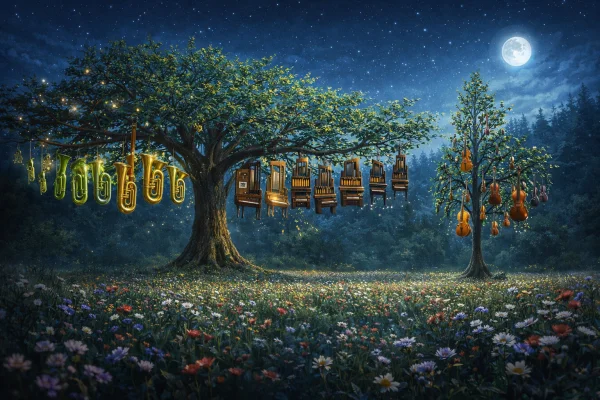
On a moonlit night in an open meadow, if you are lucky you may hear an otherworldly humming coming from the forest around you. If you remain very quiet and very sit still, a Singing Tree will emerge from the forest and begin your own private concert. Males are broader than they are tall, even when young. Adult males must be very strong because they grow the bigger instruments, like tubas, pianos and organs. Young males are also broad shouldered and grow cellos, basses and the occasional bassoon. Adult females in this classical species are very tall & narrow. They grow the medium sized strings (e.g. cello and violin), woodwinds (e.g. oboe, clarinet, etc.), and the lighter percussive instruments such as the timpani. Girls, like their mothers, are tall and slender. They grow instruments including the triangle, picolo, flute and kazoo. As with most fruit trees, defective or unfertilized fruits will never mature and so drop to the ground so as not to waste resources that would otherwise go to baby instruments that will reach maturity. Instruments from Singing Trees cannot be tuned until they are fully ripe and their voices deepen with age. In fact, early picking allows individual instruments keep their high register for life, a practice that is now frowned upon. Once late every summer, Singing Trees congregate in meadows around the world and compete for the "Golden Global", a contest that honors those Trees whose genetics make the ripest, most luscious sounding instruments. These rarified contests play to packed meadows and can last for days. All instruments are played by 3 musicians and the crowd's applause determines the final winners. As you might gather from the name, singing Cantoadustum classicus only play the classics.
0
Mar 25, 2026 2:10 AM