


Growing Pear Trees at Home: 8 Tips for Beginners
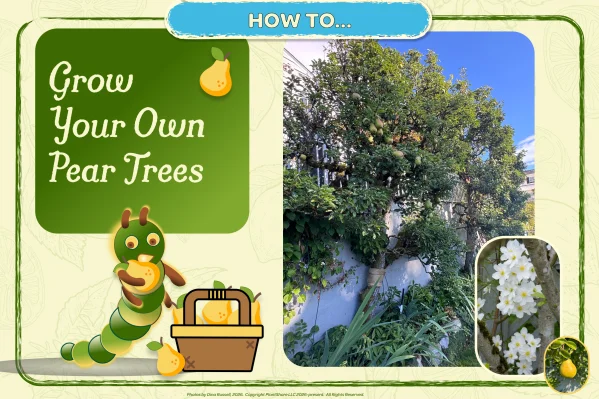
Photos by Dina Russell. Copyright PlantShare LLC 2026-present. All Rights Reserved.
Growing pears at home can be a rewarding and ‘fruitful’ ( 😂 ) project for novices. Pear trees add fragrance, pretty spring blooms and long-term structure to a landscape. In addition, they also offer abundant pollen and nectar to pollinators in the Spring. Just imagine the joys of picking fresh fruit from your own garden and the delight of baking your own pear tart, clafouti or pear compote. You can do this!
If you’re wondering how to grow pear trees, start by finding a spot with plenty of sunlight and exploring a suitable variety for your climate. Good growing conditions, especially during the first few years when the tree is becoming established, is essential for your tree to develop a strong root system and reliably produce fruit. And we at PlantShare will support you along your gardening journey.
#1. Choose the Right Pear Tree
Before buying a tree, check your USDA hardiness zone and choose a variety that can handle your local winter temperatures. You can grow pears at home if you live in climate zones 4-9.
First, decide if you want to buy a young tree sapling or an older tree. The age of the tree impacts cost, availability, difficulty of planting, and really depends on your patience! Tree age is gauged by trunk diameter; the thinner the trunk, the younger the tree. Larger trees cost more, can be harder to find, require a much larger hole, but may begin to produce fruit in the first or second year. If these considerations are not an obstacle, a larger tree, with a trunk diameter ≥ 1”, may be most satisfying.
There are different types of pear trees, and each variety has its own requirements. Some varieties perform better in colder climates, while others suit regions with milder winters. Do also check if the variety needs another compatible pear tree nearby for reliable pollination, in which case you may need space for two or more trees. Popular choices for home gardens include Bartlett, Bosc, Anjou, Comice, and Asian pears.
Besides buying from a nursery, grower or garden center, there are many considerations in picking a healthy tree that go beyond the reputation of the source. We’ll cover how to select, plant, prune and care for pears in an upcoming Growzy™ Guide, “All About Pears”, a PDF with images, recipes and tips from our founder that you’ll definitely want to keep for years to come. There are nuances and exciting options too numerous to cover here – you’re in for a treat!
#2. Picking the Best Location
Pear trees need plenty of sunlight to grow strong and produce a healthy crop. Choose a location that receives at least six hours of direct sunlight each day. More sunlight generally supports stronger growth and better fruit production.
Avoid microclimates with pockets of cold air, high humidity, and poor drainage. Pears like a bit of extra warmth. Warmth and good air circulation help keep foliage dry and reduce the risk of common fungal diseases of pears. Pear trees struggle in water-saturated or ‘heavy’ soil with high clay content. If your garden has heavy soil, you must improve drainage by amending the soil or planting on a mound. Keep in mind that pear tree roots grow deep; for example, 1-2’ of well-draining soil may work in the short term, but the tree will fail to thrive when the roots hit the heavy, possibly waterlogged, soil below that.
#3. Planting Your Pear Tree
The best time to plant pear trees depends on your climate, but early spring or fall is best for ‘establishment’ (early growth) because planting during cooler weather gives the roots time to establish before the tree faces summer heat. Trees sold as ‘bare root’ in the winter tend to be cheaper as they are less heavy without the soil. Shipping and handling costs increase with weight and a pot heavy with soil may also slow down your planting.
- Dig a hole that is twice as wide and twice as deep as the root system. Although this is a lot more work, it will greatly increase the chances for healthy growth for years to come.
- If you are planting a grafted tree, be sure that the graft union remains above the soil surface.
- Backfill the hole with good soil; ensure that there are no cavities around the roots.
- Water thoroughly.
- Mulch around the tree to conserve soil moisture and reduce weeds. Keep mulch several inches away from the trunk so the bark stays dry.
#4. Watering Your Pear Tree
Any plant needs regular watering as they establish their root system. Water deeply rather than giving the tree a small amount of water every day; you want water down where the tips of the roots are growing because that is where the roots are most actively supporting growth of the tree.
Check the soil before watering. If the top few inches feel dry, water slowly all the way around the tree and at the ‘drip line’, where water drips from the leaves during a rain. During hot or dry periods, your tree may need more frequent watering. A soaker hose or water bag can reduce your work and your worry too.
Once established, pear trees tolerate short periods of dry weather better than young trees. Consistent moisture always supports healthy growth, especially during flowering and fruit development. That said, given a choice between a dry spell and drowning the roots, choose a dry spell.
#5. Feeding Your Pear Tree
A pear tree fertilizer can help support healthy growth when your native soil lacks important nutrients or is the wrong pH. A soil test can indicate whether your garden needs additional nutrients. A home kit or agriculture center will provide the information you need.
Keep in mind that, as with most plants, more fertilizer does not necessarily mean more fruit, because excess nitrogen encourages vigorous leafy growth and reduces flowering and subsequent fruit production.
If your soil needs fertilizer:
- Organic matter, e.g. finished compost, can also improve soil structure and provide a slow source of nutrients;
- Choose a product specifically for fruit trees and follow the package instructions;
- Apply fertilizer around the root zone rather than near or against the trunk: the roots absorb the nutrients, the trunk does not;
- Early spring and after fruit production is over are the best seasons for feeding.
#6. Pruning Your Pear Tree
Regular pruning helps you maintain a strong structure and allows sunlight to reach the interior of the canopy. Start pruning when the tree is young so you can establish a balanced, healthy structure.
Pears require two different types of pruning, done at different times of the year. Heavy structural pruning is done in late winter and a light, shaping pruning is done in spring and perhaps again after fruit fall.
Whenever you prune, remove dead, damaged, or diseased branches first so you can see the structure best. Second, remove branches that cross, rub against each other, or grow toward the center of the tree. These general rules keep sunlight penetration and airflow high and humidity low inside the ‘canopy’ (the upper, spreading portions of a tree).
A rule of thumb is to never remove more than 20% of a shrub or tree at one time because that will stimulate an unhealthy burst of vigorous shoots that will stress the plant and make more work for you rather than less.
#7. Protecting Your Pear Tree
Healthy growing conditions and early detection are your first lines of defense against pests and diseases. Observe your tree in Spring and especially Summer for unusual spots on leaves, damaged shoots, insects, or poorly developing fruit. In Fall, leaving healthy leaves under the tree retains moisture, keeps the roots warm during winter and reduces weeds. However, leaving diseased leaves and fruit under the tree is ill-advised. Fortunately, there are treatments for the following most common issues.

Figure 1. Rust on the upper side of a pear leaf and blisters on the underside.

Figure 2. Orange spores (left on hand holding the leaf) will stain cloth and paper.
Images by Dina Russell.
Several rusts in the fungal genus Gymnosporangium will infect pears, forming red-orange spores on the front surface of the leaf and later in the season, blisters on the back. These fungi have a complex life cycle, living on pears or apples in spring and summer, then overwintering in evergreens such as Deodara Cedars.
A second common pathogen of pears is codling moth (Cydia pomonella). The larvae of the codling moth tunnel into developing fruit leaving a pucker at the entry point. Larvae often leave behind ‘frass’ – excrement that looks like dark sawdust – near the entry point. Infested pears tend to be small, misshapen and drop early. It’s easy to monitor the fruit and your tree during the growing season: check out the helpful photo montage below. Happy sleuthing!
Remove affected fruit, and use appropriate control measures as needed. For example, this year, Dina was wrapping the trunk of my pear trees as recommended by the Washington Extension to keep the moth population in check. Check out our YouTube to see how!

Figure 3. Central image: a portion of the trunk of a mature pear tree (Pyrus communis), wrapped in burlap to attract and trap 5th instar larvae as they seek a protected place to pupate. Clockwise from top left: caterpillar larva eating fruit, pupa, female and male adult moths. Outer four images from Codling Moth, Wikipedia.
#8. When Will My Pear Tree Finally Produce Fruit?
Be patient! A newly planted tree may need several years before it produces a meaningful crop. The exact timing depends on the variety, rootstock, growing conditions, and age of the tree when you plant it.
Pollination also matters. Some pear varieties produce fruit more reliably when another compatible pear variety grows nearby and blooms at approximately the same time.
Finally, expecting a large harvest from a young tree is unrealistic and has nothing to do with the care that you are providing; it’s just the biology of the plant. Focus on establishing healthy roots, strong branches, and consistent growth and let the tree do the rest.
And remember, you will begin to enjoy the flowers well before harvesting your first crop of delicious pears.


Figure 3. Two styles of flower arrangements with pear blossoms. Spring pruning is a great time to enjoy pear blossoms indoors. Cut stems in the morning early in the season when the flower clusters are still closed. Arrange in your favorite vase and enjoy the show for 1-3 weeks as the flowers within each cluster slowly open, emit a delicate scent, then ‘snow’ a drift of petals as the blooms fade.
PlantShare for Curious Gardeners
PlantShare gives plant lovers a place to discover plants, explore plant profiles, learn about gardening, and connect with other people who share an interest in growing plants. You can use our platform to explore necessary information about how to create your own garden, discover gardening ideas and designs for your backyard or container garden, and build your knowledge as you develop your own garden.
PlantShare can help you explore plants and find useful information for your gardening journey. Contact us at info@plant-share.com or book a consultation with our experts straight away. Create an account so you don't miss our updates and upcoming new features!
FAQ
How big do pear trees grow?
Pear trees reach different sizes depending on their variety and rootstock. Standard pear trees can become quite large, while dwarf and semi-dwarf varieties remain smaller and work better for many home gardens. Check the mature size before planting so you can provide enough space.
How to take care of pear trees?
Pear trees require full sun, well-draining soil, consistent water, appropriate nutrition, and regular pruning. Monitor your tree for pests and diseases, remove damaged growth, and keep weeds away from the root zone.
When to plant pear trees?
The best time to plant pear trees usually falls in early spring or fall, depending on your local climate. Avoid planting when the ground remains frozen or during periods of extreme heat.
How fast do pear trees grow?
Pear trees tend to grow at a moderate rate; however, growth depends on the variety, rootstock, soil, water, sunlight, and overall care. Young trees must focus on establishing roots and branches before producing significant amounts of fruit.
When do pear trees bloom?
Pear trees typically bloom in spring. The exact timing varies by variety and climate. White flower clusters usually appear before the tree develops its full summer foliage. You can cut the stems before the flower clusters open - a delight to watch unfold in your home!
When to prune a pear tree?
For major structural pruning, late winter, while the tree remains dormant, is best. Remove dead, damaged, crossing, and poorly positioned branches. Avoid excessive pruning, particularly on young trees. The rule of thumb is to remove <20% of the tree at any one time.
***
REFERENCES
Pear Rust (species in the fungal genus Gymnosporangium):
https://extension.okstate.edu/fact-sheets/pear-rust
Codling Moth (Cydia pomonella):
https://hortsense.cahnrs.wsu.edu/fact-sheet/pear-codling-moth/