



 Garden The PlantShare Way ®

~ All About Moroccan Mound Spurge ~


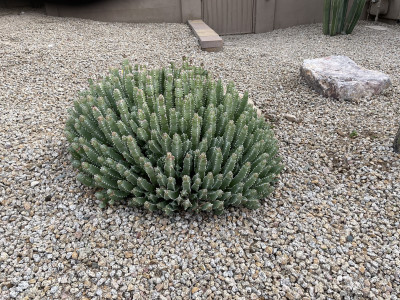
The Euphorbia resinifera is a striking, low-maintenance succulent native to Morocco. Known for its geometric clumps of spiny, blue-green stems, it’s an excellent choice for arid gardens and drought-tolerant landscapes. Understanding proper plant care will help you keep this plant healthy and thriving for years.
Plant Euphorbia resinifera in full sun with well-draining soil, such as sandy or rocky mixes. It tolerates poor soil but does best in conditions that mimic its natural desert habitat. Water sparingly, only when the soil is completely dry, as overwatering can quickly lead to root rot. This plant also handles heat and occasional cold snaps but should be protected from frost. Minimal pruning is needed, though removing damaged stems can improve appearance.
To create a balanced and visually appealing landscape, Tecoma stans (commonly known as Yellow Bells) makes an excellent companion plant for Euphorbia resinifera. Tecoma stans is a sun-loving, drought-tolerant shrub or small tree that produces bright yellow, trumpet-shaped flowers for much of the warm season. Its softer foliage and upright form contrast nicely with the rigid, sculptural stems of Euphorbia resinifera, while sharing similar water and soil needs. Both plants thrive in full sun and well-draining soil, making them easy to maintain together in xeriscape or desert-style gardens.
Beyond its ornamental appeal, there are notable medicinal uses of Euphorbia resinifera. Historically, its latex resin was used in traditional medicine for pain relief and as an anti-inflammatory. In modern research, resinifera-derived compounds are being studied for their potential in pain management, especially for severe chronic pain. However, the latex is toxic and can cause skin and eye irritation, so handling should be done with gloves, and internal use should only be under professional supervision.
In landscaping, Euphorbia resinifera works well as a focal plant, in rock gardens, or as part of a xeriscape design. It’s also deer- and rabbit-resistant, making it suitable for areas with wildlife browsing concerns.
With the right plant care, you’ll enjoy a plant that is both visually unique and historically significant. Combining its bold structure, drought tolerance, and the fascinating history of Euphorbia resinifera medicinal uses, this succulent offers gardeners both beauty and a connection to centuries-old botanical knowledge. For beginners seeking a resilient yet exotic plant, it’s a standout choice.
Hesperaloe funifera can grow 4–6 feet tall and about the same width. Its flower stalks can reach up to 15 feet in height.
Last updated on Nov 16, 2026
Species suggested by: Catherine Ko, 2023
Plant Profile compiled and written by: Tai Black
Contributors: Team PlantShare & Catherine Ko
 Ask Us!