



 Garden The PlantShare Way ®

~ All About Weeping Blue Atlas Cedar ~


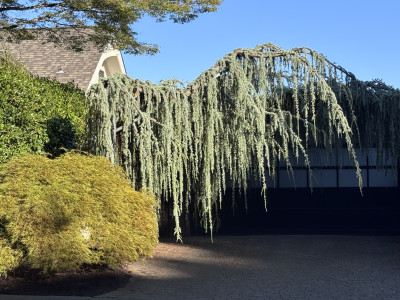
Cedrus atlantica ‘Glauca Pendula’, commonly known as Weeping Blue Atlas cedar, is an evergreen conifer valued for its silvery blue-gray needles and distinctive cascading branches. Its irregular, weeping growth habit makes it an attractive focal point in gardens. With the right planting location and basic care, this ornamental conifer can thrive for many years.
Choose a sunny planting location with at least six hours of direct sunlight each day. Cedrus atlantica ‘Glauca Pendula’ grows best in well-draining soil and can tolerate several soil types once established. Avoid low-lying areas where water collects, as consistently wet soil can damage the roots. Water young trees regularly during their first few growing seasons, then adjust watering according to rainfall and soil moisture.
When planting a Weeping Blue Atlas Cedar, consider its root system and distinctive growth habit. Choose a permanent location with enough space for the roots and cascading branches to develop without crowding buildings, paths, or nearby plants. This cultivar can be difficult to transplant once established, so careful site selection is important. Apply a layer of mulch around the root zone to retain moisture and suppress weeds, keeping mulch away from the trunk.
Pruning Cedrus atlantica ‘Glauca Pendula’ requires a gentle approach to preserve its natural shape. Its long, drooping branches are the main feature of this cultivar, so avoid cutting back healthy growth unnecessarily. Remove dead, damaged, or crossing branches using clean pruning tools. The tree's final form depends largely on how it is trained when young. If you want it to grow upward before its branches cascade, support and guide a suitable central leader early in its development. Check the tree's structure periodically and adjust supports as needed.
As a companion plant, Imperata cylindrica ‘Rubra’, commonly known as Japanese Blood Grass, can add contrasting color and texture around Cedrus atlantica ‘Glauca Pendula’. Its narrow leaves develop vivid red tips that deepen in color during the growing season, creating a striking contrast with the cedar’s silvery blue-gray needles. Both plants prefer full sun and well-draining soil, making them suitable for the same garden environment. However, plant Japanese Blood Grass with caution, as some forms of Imperata cylindrica can spread aggressively through rhizomes and become invasive; once entwined with the Cedar, any 'running' grass will be hard to remove. Check local regulations and choose a non-invasive alternative if necessary. If planting it, use a container or an effective root barrier to limit its spread, and leave sufficient space for the cedar’s cascading branches to develop without obstruction.
With full sun, well-draining soil, and careful early training, Cedrus atlantica ‘Glauca Pendula’ can become a long-lasting landscape feature. Its silvery blue foliage and graceful, weeping form make it particularly suitable as a specimen tree in a spacious garden, where its distinctive shape can be fully appreciated.
Cedrus atlantica ‘Glauca Pendula’ grows best in full sun, with at least 6 hours of direct sunlight each day. It can tolerate light shade, but too little sunlight may limit its growth.
Weeping Blue Atlas Cedar is a slow-growing tree. Its growth rate depends on growing conditions and how it is trained or pruned. It typically grows around 6–12 inches (15–30 cm) per year.
Yes, it is an evergreen conifer that keeps its blue-gray needles throughout the year. Its distinctive weeping branches give it a graceful appearance in every season.
Yes, it produces cones as it matures. The cones are usually barrel-shaped and may take two or more years to mature. They start green and turn brown as they develop.
Last updated on Oct 22, 2026
Species suggested by: Dina Russell, 2026
Plant Profile compiled and written by: Team PlantShare
Contributors: Team PlantShare
 Ask Us!